What you will learn
- We know of no FAR or DFARS clause that bans AI in proposal writing or requires you to disclose it, and the FAR overhaul text and its proposed rules do not mention AI.
- Read the solicitation. Section L, the clauses and any amendment can add AI terms. The AI rules agencies have issued so far mostly cover AI used to perform the contract, not to write the bid.
- You own every word. False statements (
18 U.S.C. 1001), the False Claims Act, where "reckless disregard" counts as knowing (31 U.S.C. 3729), and the signer's certification (FAR 52.203-2) apply with or without AI. - Evaluators score only the factors in the solicitation (
FAR 15.305(a)), but buyer guidance tells them to test polished claims with orals and demonstrations. - The daily risk is data. Public RFP text is public; CUI, export-controlled drawings and your own pricing need a tool that meets the rules their markings and your contract set.
Chapter 01of 071 min
Is it legal to use AI to write a government proposal?
For federal contracts, generally yes. As of October 2026 we know of no FAR or DFARS clause that bans using AI to write a proposal or requires you to say that you did. A search of the current FAR (FAC 2026-01) and DFARS parts that govern solicitations, proposals and contract clauses finds no mention of artificial intelligence, generative tools or language models.
The same is true of the FAR overhaul. Its new text is not final: eight of the twelve planned proposed rules were published on June 23 and September 18, 2026, and agencies apply the new text through class deviations. None of those rules mentions AI. The overhaul also renumbers the parts you know: the uniform contract format that defines Sections L and M moves from FAR 15.204-1 to 15.109, and the rule that proposals are scored only on the stated factors moves from FAR 15.305(a) to 15.202(a)(1) in the Part 15 text.
The AI language we found in the overhaul materials is advice to buyers in the non-regulatory FAR Companion. It says an oral presentation or demonstration "allows the government to discern actual capabilities of offerors (e.g., vice their use of proposal writers or artificial intelligence in proposal preparation)."
Chapter 02of 071 min
Read the solicitation first: where AI terms show up
Any single solicitation can add its own AI terms, and those terms bind you on that bid. Look in the cover letter, Section L instructions, Section H special requirements, Section I clauses and every amendment. For a state or local bid, read the instructions to proposers and the terms and conditions. Some solicitations now ask offerors about AI use. When one asks, answer exactly what it asks, in the place it asks.
The AI rules agencies have issued so far are mostly about AI in the work you would deliver, not the proposal itself:
| Rule | What it covers | About writing the proposal? |
|---|---|---|
| GSA class deviation adding GSAR 552.239-7001 (Sept 2026) | Safeguards when GSA buys a language model system and Government Data goes into it. A contractor's internal back-office use is excluded. | No |
| OMB M-25-22, section 3.h | Agencies decide case by case whether a solicitation should require disclosure of AI used in contract performance. AI a contractor uses incidentally is out of scope. | No |
| A July 2026 ICE construction IDIQ solicitation (70CMSW26R00000012) | Offerors disclose any plan to use AI to perform the contract; the government may approve or disapprove it. | No |
| California SCM 2302 | Bidders tell the State if they will deliver GenAI or use it to produce deliverables; failure to report "may result in disqualification". | No |
| District of Columbia AI clause | The offeror notifies the contracting officer if its solution or service includes AI. | No |
If a solicitation is silent on AI, there is nothing to disclose about how you drafted it. If it asks about AI in performance, answer for the work you propose. If it asks about AI in the proposal itself, answer that question too. When in doubt, send a question to the contracting officer during the Q&A period, as you would for any unclear instruction.
Chapter 03of 071 min
You own every word: accuracy, certification and liability
Using AI changes nothing about who is responsible for the proposal. A knowing and willful materially false statement in a matter within federal jurisdiction is a crime under 18 U.S.C. 1001. Under the False Claims Act, "knowingly" includes acting in "reckless disregard of the truth or falsity of the information" and needs "no proof of specific intent to defraud". Under FAR 52.203-2(b), "each signature on the offer is considered to be a certification by the signatory". A conviction or civil judgment for false statements is a cause for debarment under FAR 9.406-2.
Key personnel and past performance are where unchecked drafts do the most harm. GAO treats a proposal that "knowingly or negligently" relies on people the offeror had no reasonable basis to provide as a material misrepresentation (JANUS Research Group, B-423686.2, 2026). "Negligently" matters: an AI-drafted resume, staffing claim or past performance write-up that nobody checked is still your representation.
GAO has already dealt with AI-style errors, though in protest filings rather than proposals. It dismissed protests over citations to decisions that do not exist and warned of sanctions (B-423447, 2025; B-423649, 2025; B-424064, 2026). The problem GAO named was that the filer "did not take care to verify its research", not the use of AI. We found no GAO or court decision that rejects a proposal because AI wrote it.
Chapter 04of 071 min
Can evaluators detect AI, and does it lower your score?
Agencies "shall evaluate competitive proposals and then assess their relative qualities solely on the factors and subfactors specified in the solicitation" (FAR 15.305(a); 15.202(a)(1) in the overhaul text). So AI use is not graded unless the solicitation makes it a factor. We found no sign that agencies run AI detectors on contract proposals; the one detection statement we found is from NIH, about grant applications.
What evaluators do notice is generic writing: confident paragraphs that restate the requirement without a method, a named person, a number or a past result. That loses points under any Section M, and AI tools produce it easily when they are fed only the RFP. Feed the draft your own evidence and edit for specifics.
The government is also starting to use AI on its side. Law firms report a 2026 special operations solicitation saying the government may use AI to help analyze proposals, with decisions made only by government personnel, and a 2026 Court of Federal Claims ruling (TRAX International, No. 26-796) that AI evaluation reports an agency considered belong in the record (Burr & Forman; National Law Review). Write for a careful human reader and for a tool that checks your proposal against Section M.
Chapter 05of 071 min
What you may put into an AI tool
The bigger day-to-day question is confidentiality. Sort the documents before anything goes into a tool, because what is in the file decides the rule:
| What it is | Rule that applies | What it means for an AI tool |
|---|---|---|
| Public RFP text posted on SAM.gov | Public information | No CUI or export rule; your own confidentiality choices apply. |
| CUI-marked attachments | 32 CFR 2002; the contract's handling terms; on DoD work DFARS 252.204-7012 | Only a system that meets the required safeguards. |
| Export-controlled technical data | 22 CFR 120 (ITAR) and 15 CFR 734 (EAR) | No release to foreign persons; a service that decrypts the file to process it is not covered by the encryption carve-out. |
| Your own proposal content, pricing and rates | Your trade secrets; the FAR 52.215-1(e) legend protects them from disclosure by the government | The legend does not bind your tool vendor: read the tool's data use and training terms. |
| Another offeror's bid data or source selection information | 41 U.S.C. 2102; FAR 3.104 | Do not obtain or use it at all. |
For CUI on contractor systems, agencies "must use NIST SP 800-171" to set the safeguards (32 CFR 2002.14(h)(2)), and on defense contracts a cloud service that stores or processes covered defense information must meet security requirements equivalent to the FedRAMP Moderate baseline (DFARS 252.204-7012(b)(2)(ii)(D)). A CUI-marked attachment is still CUI before award. A proposed FAR provision, 52.240-6, would also bar offerors from using government-provided information for their own purposes and ask them to report CUI incidents within 72 hours; it is not final.
One more check on federal bids: under FAR 52.204-29, you represent, after a reasonable inquiry, that you will not provide or use a product covered by a FASCSA exclusion order in response to the solicitation. If an order ever names an AI product you use, ask the contracting officer how it applies to your bid.
Chapter 06of 071 min
Grants and state and local bids are different
- Grants are stricter than contracts. NIH will not treat applications "substantially developed by AI" as original ideas of the applicant, from the September 25, 2025 receipt date (NOT-OD-25-132).
- NSF encourages proposers to say how they used generative AI (NSF notice) and counts AI-assisted fabrication as research misconduct for awards from December 8, 2025 (NSF 26-200).
- NASA science grants allow AI tools but ask proposers to cite the tool, version, date and how it was used (NASA SMD FAQ).
- State and local bids: the rules we found (California SCM 2302, the District of Columbia clause) cover AI in the work you deliver. We found no state rule on AI used to write the bid itself, so read each RFP's instructions.
- Do not carry a grant rule into a FAR-based RFP, or the other way around.
Chapter 07of 072 min
A safe way to use AI on a government proposal
- 1
Read the solicitation's AI terms first
Check the cover letter, Section L, Sections H and I and every amendment for AI, data handling or disclosure language before the first draft. Note anything that limits tools or providers.
- 2
Sort the files before anything goes into a tool
Public RFP text, CUI-marked attachments, export-controlled data and your own pricing each follow different rules. Keep CUI and export-controlled files out of any tool that does not meet their safeguards.
- 3
Draft from your own records
Give the AI your past performance, resumes, capabilities and the outline built from Section L and M. A draft that starts from your evidence needs far less fixing than one that starts from the RFP alone.
- 4
Mark gaps instead of filling them
Where your records have no answer, the draft should say so with a visible marker. A gap you can see gets fixed; a plausible invention gets submitted.
- 5
Verify every fact before review
Names, dates, contract numbers, dollar values, certifications and citations, each checked against the source. Make it a named step in your review, not an assumption.
- 6
Keep a human final review and sign-off
Someone who did not write the proposal reads the final version against the solicitation and signs off. Keep a short note of which tools you used and how, so you can answer accurately if the agency asks.
Before you submit a proposal AI helped write
- The solicitation's AI, data handling and disclosure terms are read, and any question about them is answered.
- No CUI, export-controlled data or other offerors' information went into a tool that is not cleared for it.
- Every resume, past performance entry and staffing claim is checked against your records.
- Every number, date, name and citation has a source you can point to.
- Generic passages are rewritten with your method, people and results.
- A reviewer who did not write it has signed off on the final version.
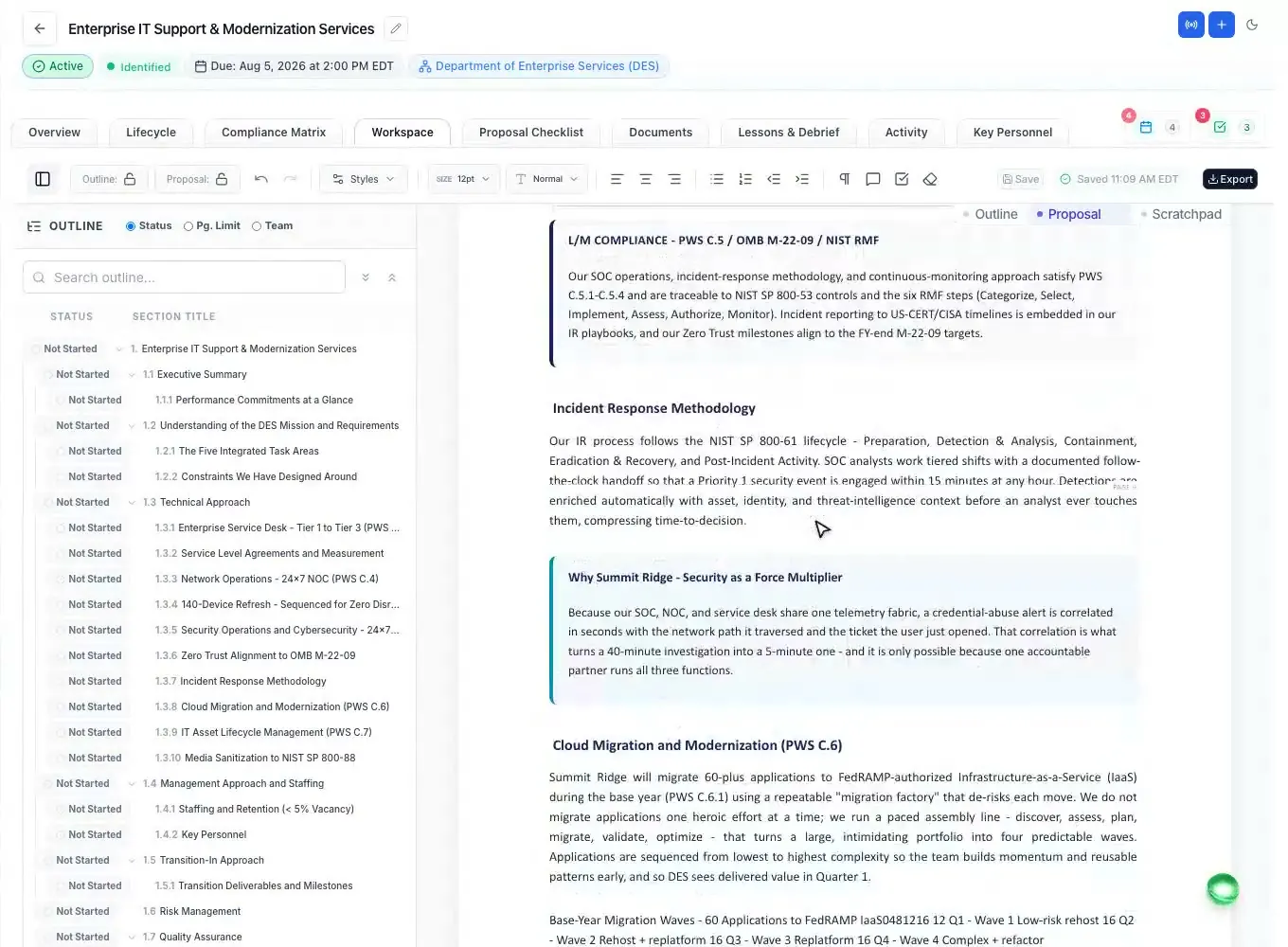
If you use ProposalWorkspace, the AI proposal writer is built around these steps: it drafts from the outline and your Company Library, marks gaps, and works inside the proposal editor, where AI edits can arrive as tracked changes. This guide is general information, not legal advice; for a specific bid, ask your counsel or the contracting officer.
Before you go
Questions people ask
- Can I use AI to write a government proposal?
- For federal contracts, generally yes. As of October 2026 we know of no FAR or DFARS clause that bans it, and the FAR overhaul proposed rules do not mention AI. A solicitation can still add its own AI terms, so read Section L, the clauses and every amendment first.
- Do I have to disclose that I used AI to write my proposal?
- Not under any FAR or DFARS clause we know of. The disclosure duties we found, such as GSA's GSAR 552.239-7001 and a 2026 ICE solicitation, cover AI used to perform the contract. If a solicitation asks about AI use, answer exactly as it asks.
- Can the government detect AI in a proposal?
- We found no sign that agencies run AI detectors on contract proposals; NIH says it uses detection for grant applications. Evaluators score only the stated factors (FAR 15.305(a)), but buyer guidance tells them to test polished claims with orals and demonstrations, so write only what you can prove.
- Does using AI affect certifying the proposal?
- No, the certification is the same, and so is the responsibility. Each signature on the offer is a certification by the signer (FAR 52.203-2(b)), false statements are covered by 18 U.S.C. 1001, and the False Claims Act treats reckless disregard as knowing. Check every AI-written fact before you sign.
- How should we handle CUI when we use AI?
- Keep CUI out of any AI tool that does not meet the safeguards the CUI requires. On contractor systems that means NIST SP 800-171 (32 CFR 2002.14(h)(2)), and on defense contracts a cloud service holding covered defense information must meet FedRAMP Moderate equivalent (DFARS 252.204-7012). Public RFP text is not CUI.
- Can contractors use a general AI chatbot for proposals?
- Nothing in the FAR forbids it, but read the tool's data terms: a general chatbot may keep or learn from what you paste in, and the FAR 52.215-1(e) proprietary legend does not bind a tool vendor. Never paste CUI, export-controlled data or your pricing into a tool that is not cleared for it, and check every claim it writes.
- Are the rules different for grant applications?
- Yes, and stricter. NIH will not treat applications substantially developed by AI as original ideas, NSF encourages disclosure and treats AI-assisted fabrication as misconduct, and NASA science grants ask you to cite any AI tool used.
How ProposalWorkspace handles this
An AI proposal writer that marks what it cannot prove
ProposalWorkspace's built-in AI drafts each section from your outline and your Company Library, and marks where your input is still needed instead of inventing it. With Suggesting mode on, every AI edit lands as a tracked change, and a final RFP proposal cannot move to submission until someone who did not write it signs off. Each workspace is isolated at the data layer and documents are encrypted in transit and at rest. There is no FedRAMP authorization or SOC 2 report, so work with CUI is not a fit. If a contract limits which AI providers you may use, ask us which providers the built-in AI uses: support@proposalworkspace.com.
Up next
Pink, Red and Gold Team reviews: what each one checks
Color team reviews are how experienced proposal teams catch problems while there is still time to fix them. Each review has one question to answer. Run them with the right people, against the solicitation, on a schedule set on day one, and the Red Team stops being the place where proposals get rewritten.
7 min
New proposal guides, by email
One email when we publish a new proposal guide for companies that bid to federal and state agencies, and the occasional product update. No drip campaigns, no sharing your address, unsubscribe with one click.
This guide is general information for federal contractors drawn from the FAR and standard capture and proposal practice. It is not legal advice; always read the specific solicitation and consult counsel on protests, contract terms and compliance questions.